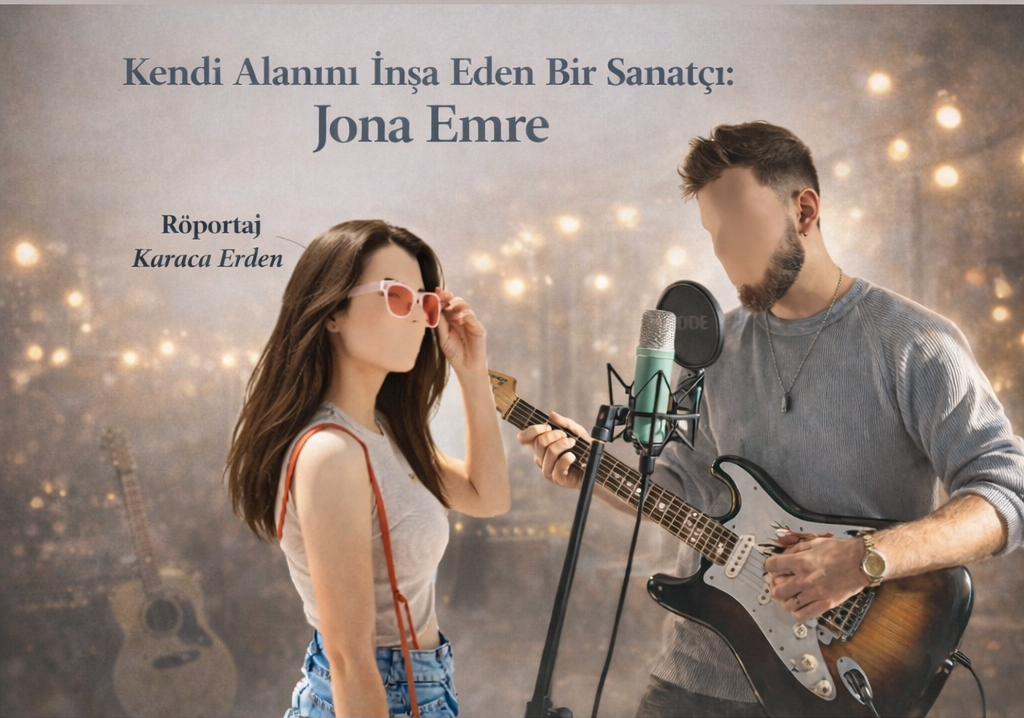
Interview: An Artist Building His Own Domain: Jona Emre
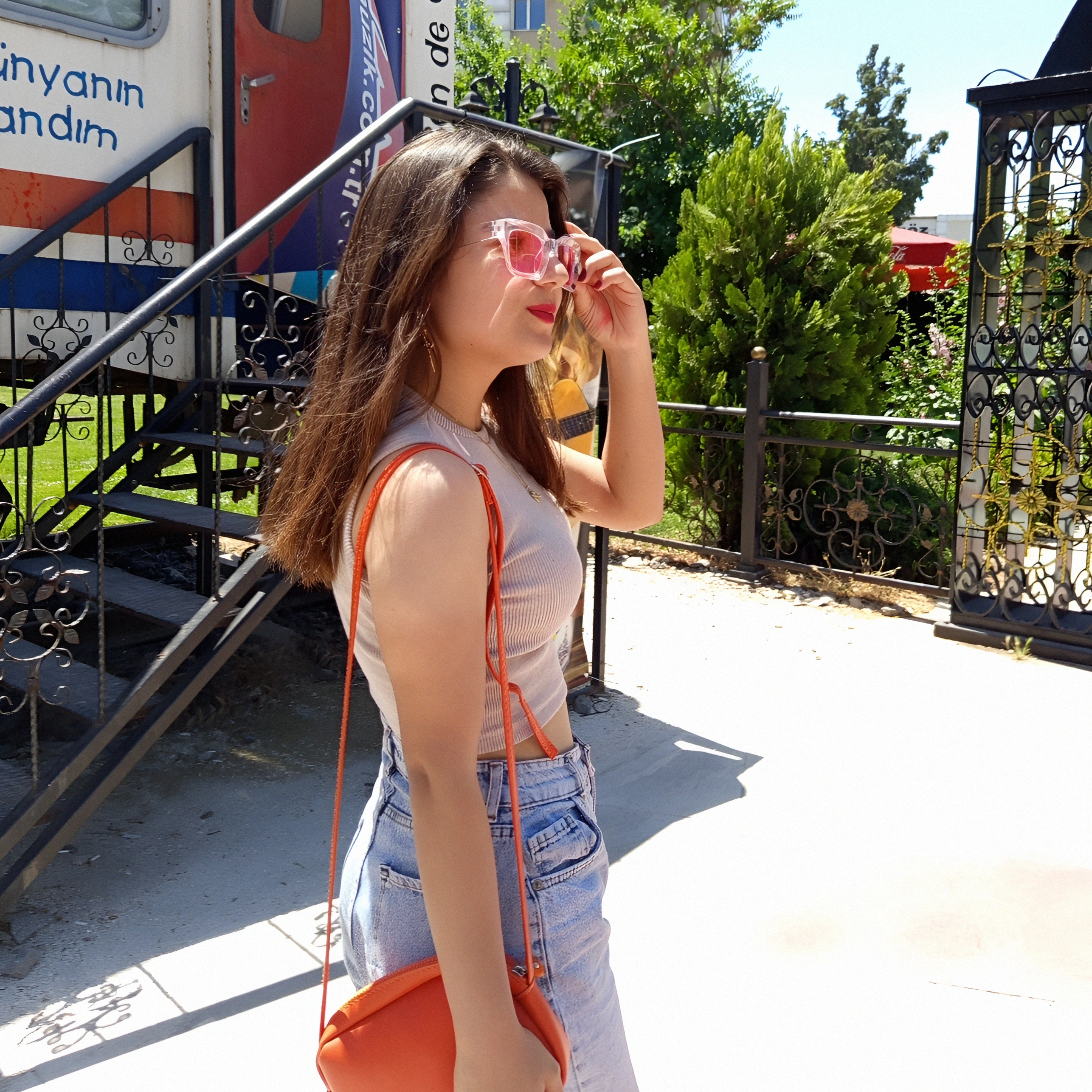
Text and Interview: Karaca Erden
There are people who refuse to confine their lives to a single field. On one side, a demanding professional discipline; on the other, an irrepressible need to create. Jona Emre is one of those names who, while continuing his education in veterinary medicine, is also carving out his own path and language in music.
His production journey—stretching from industrial metal to alternative rock—is shaped by a multicultural background, an unrelenting work pace, and a personality that, in his own words, “cannot tolerate anything left unresolved.”
In this interview, we spoke with Jona Emre about his first encounters with music, how he keeps producing through exhausting periods, and how he builds his own space.
Interview: An Artist Building His Own Domain: Jona Emre
Text and Interview: Karaca Erden
Karaca Erden:
Hello dear readers,
Today at the Yazbikose interview table, we are joined by Jona Emre, who continues his career in veterinary medicine while also taking his first serious steps into music production.
Welcome, Jona Emre.
To begin, could you tell us a little about yourself? How would you briefly introduce who you are?
Jona Emre:
I’m Jona Emre. I was born in 2003 in Grenchen, Switzerland. My father is Swiss, my mother Turkish. I lived in Zurich until I was ten, then moved to Turkey, where I still live. I continue my education here and am currently a fourth-year veterinary medicine student.
Karaca Erden:
Let’s start with a general question. What three words describe you best?
Jona Emre:
Perfectionist.
Driven.
Boundary-pushing.
Karaca Erden:
When you talk about yourself, do you feel closer to calling yourself a musician or a veterinarian?
Jona Emre:
I wouldn’t define myself by a single profession or activity, but in terms of a profession, I’m definitely a veterinarian.
Music, on the other hand, is another tone of life.
Karaca Erden:
How did you decide to pursue music while being immersed in such an intense field as veterinary medicine?
Jona Emre:
I’ve always had an interest in music. My sense of rhythm is almost instinctive; I can separate complex sounds instrument by instrument and focus on them mentally.
In high school, instead of paying attention to classes, I’d compose during lessons and try to make R&B tracks—unsuccessfully, of course. I had compositions in French, English, and German. I’ve always had diverse interests. Before that, in my first year of high school, I was writing scripts, assembling teams, and attempting to make short films. I even remember attaching a microphone to a mop handle because I didn’t have a proper stand. Equipment was my biggest problem; I sold personal items through second-hand apps just to buy a microphone, sometimes even sold my phone.
As for returning seriously to music in its current form: my first year at university had just ended, and we were on a family trip to Cappadocia. During a car ride, I listened—properly, for the first time—to a German metal band I’d heard of but never really paid attention to: Rammstein. It completely mesmerized me. The accent, the baritone voice meeting artistic rhythm—it captivated me, and I found myself repeating it constantly. Over time, I realized my voice, my German, and my accent fit this style very well.
In my second year, I thought about forming a tribute metal band, but I couldn’t find the right people. My faculty schedule didn’t allow it—we were extremely busy, and our building was on the far edge of campus, so meeting people from outside was difficult. By my third year, I decided something had to change. I’m allergic to things that never reach a conclusion. I searched for people and eventually found some, but the process was painful. Members would come and go, and an entire semester passed dealing with these issues. We rehearsed effects and setups, but always as a duo. The constant postponement led to a deep sense of frustration.
Around June, I said, “I’ll do this on my own.” It was the only way.
Every summer, I worked in Switzerland, in a warehouse. I memorized my compositions, sang them while driving a forklift, arranged verses and rhymes in my head.
Before my fourth year, there was a mandatory internship. After one month abroad, I returned to Turkey and started the internship the very next day. I had no vacation at all. University, then work the next day, then internship—six weeks straight, from 8:40 a.m. to 5:00 p.m.
Not having a break exhausted me. Even during the internship, I completed compositions and used the money I earned to buy second-hand but high-quality equipment, and started recording. It dragged on until midterms—longer than expected—but after exams, I began sharing my work. And here we are.
Karaca Erden:
How did having a Turkish mother and a Swiss father shape your identity and worldview? Do you think this multicultural background reflects in your music?
Jona Emre:
It didn’t have a major effect. I wasn’t deeply immersed in a specific culture growing up. Apart from holidays, there wasn’t much. Still, I feel closer to Turkish culture in terms of sensitivity and hospitality.
It hasn’t directly influenced my music.
Karaca Erden:
How has producing in different languages and styles shaped your approach to music? Do you feel you belong to one place, or is being “in between” your space?
Jona Emre:
At first, as I said, I only considered a German tribute band—I never thought about Turkish. I didn’t even listen to Turkish music. Honestly, I didn’t think Turkish fit songs well. Over time, I asked myself, “Why not make something local or original? How far could I really go in German?”
So I tried fitting Turkish into industrial metal. At first, it either sounded ridiculous or unfamiliar simply because I’d never heard it before. Over time, by doing and repeating it, I got used to it. Listeners will go through the same cycle. I also started listening to popular Turkish bands and eventually grew to like them.
The reason I move in two categories is simple: my core is industrial metal, but occasionally I explore melancholy and alternative rock purely out of taste. Industrial metal is niche; alternative rock resonates more in Turkey. For the former, the audience’s ear still needs to be trained—the field is empty.
Karaca Erden:
How did living at such a pace affect you physically and mentally? Was there a moment when you said, “I’m exhausted”?
Jona Emre:
Throughout university, that was my standard line. But the third and fourth years—especially never having a vacation—drained me mentally, and I still haven’t fully recovered. I’ve worked since a young age because I never took money from my family. My father never said, “Here’s some pocket money, go have fun.” He said, “Go earn it.” It’s frustrating as a child, but in the long run, it made me extremely responsible.
Karaca Erden:
You mentioned composing while driving a forklift. Can we say music kept you going during that intensity?
Jona Emre:
Absolutely. If I hadn’t kept my mind busy, I would’ve lost it. Working nine hours in a warehouse is mentally exhausting. I’d arrive at four in the morning, and doing anything outside my own department made me anxious. Writing music there became a kind of therapy—or blinders, keeping me focused.
Karaca Erden:
Continuing to produce even during your internship shows how strong your bond with music is. Was there anything that could have stopped you at that point?
Jona Emre:
Everything that could stop me already had in previous years. But as I said, unresolved things haunt me—they trigger something like an allergy.
Karaca Erden:
When you started recording, was there a moment when you thought, “This is real now”?
Jona Emre:
Yes. Listening back to the recordings, or sending them to people close to me and getting their reactions—that’s when it felt real.
Karaca Erden:
Your track “Plasebo” stands out on social media. Could you tell us about its creation process?
Jona Emre:
It was similar to the others. The difference is that I wrote it while extremely exhausted. You know that moment when you come home dead tired and want to sleep, but instead you linger in that fatigue? That’s when most of it was written. It also echoes the “what-ifs” left inside me after a breakup.
Karaca Erden:
How did the reactions after your first releases affect you?
Jona Emre:
My first release was in Turkish, and the response was quite good. But it opens a new door, and not everything goes as expected. Sometimes people you’re very close to don’t react at all. It’s surprising—and makes you think.
Karaca Erden:
How many tracks have you released so far?
Jona Emre:
Four, and the fifth is about to come out.
Karaca Erden:
Did you face the kind of prejudiced comments many artists encounter early on? How did you deal with them?
Jona Emre:
In real life, people are mostly kind. Social media is strange—either very positive or extremely negative. Balanced, reasonable comments are rare. Negative ones usually come from people looking to vent anger, saying things like “quit” or accusing the work of being artificial. I don’t care much. If there’s a logical critique, I think about it. Someone once said the lyrics were hard to understand, so I added subtitles to later videos.
Karaca Erden:
What kind of work can we expect from you in the future? Will you stay loyal to your style or experiment?
Jona Emre:
I’ll primarily continue with industrial metal. I won’t deviate from that path. I aim to be its representative in Turkey. Of course, I’ll occasionally explore other themes—love, and so on.
Karaca Erden:
Many people wonder: what defines a musical style, and how does it form? Do you work within a set genre, or do you have your own?
Jona Emre:
In Turkey, what I do is unconventional—something ears here aren’t familiar with. Rammstein is popular in Turkey; why shouldn’t it be in Turkish? That baritone, emphatic vocal style actually exists in old Anatolian rock as well—artists like Barış Manço or Cem Karaca.
Karaca Erden:
Beyond music, are there goals in your life you say, “I will definitely achieve this”?
Jona Emre:
There are many, but I won’t frame them as career or hobby goals. I don’t seek approval or validation. We live once. I just want to fully use this second chance—life itself. If possible, I’d live every day differently; then life would feel like two hundred years.
Karaca Erden:
As an artist, how would you like listeners to describe you?
Jona Emre:
Rather than a good singer, a good writer. I want to offer a meaningful alternative to those tired of meaningless lyrics. I care that every line carries meaning.
Karaca Erden:
What would you say to someone just starting to create?
Jona Emre:
Just do it. Don’t think. Thinking only makes you spin your wheels.
Karaca Erden:
What would today’s Jona Emre say to his past self?
Jona Emre:
I wouldn’t say anything—I’d probably shake him. I regret wasting time, drifting aimlessly, childish rebellion.
Karaca Erden:
Finally, how did your family react to your decision to pursue music? Do you think families should have a say in our dreams?
Jona Emre:
My family has been fully supportive. They’ve never said anything negative.
Karaca Erden:
We had a wonderful conversation with Jona Emre and got to know him more closely. Is there anything you’d like to add?
Jona Emre:
When I said “my second chance,” I meant surviving a brain hemorrhage at age four. I was close to death and survived in an inexplicable way. It shook everyone around me deeply. I couldn’t walk, speak, or feel. After one to two years of rehabilitation, isolated even from my family at times, I returned closer to normal—but with lasting effects, like becoming left-handed instead of right-handed.
Our conversation with Jona Emre tells not only the story of making music, but also of carving out one’s own space in life—of balancing obligation and passion.
Despite an intense education, relentless work, and mental exhaustion, he continues to create, using music not as an escape, but as an anchor.
As an artist who clarifies his path, pushes his limits, and has something to say, Jona Emre’s journey is one we will continue to follow.
Yorumlar